Notre Dame Dominates Stanford 58-7 Behind Historic Jonaz Walton Performance
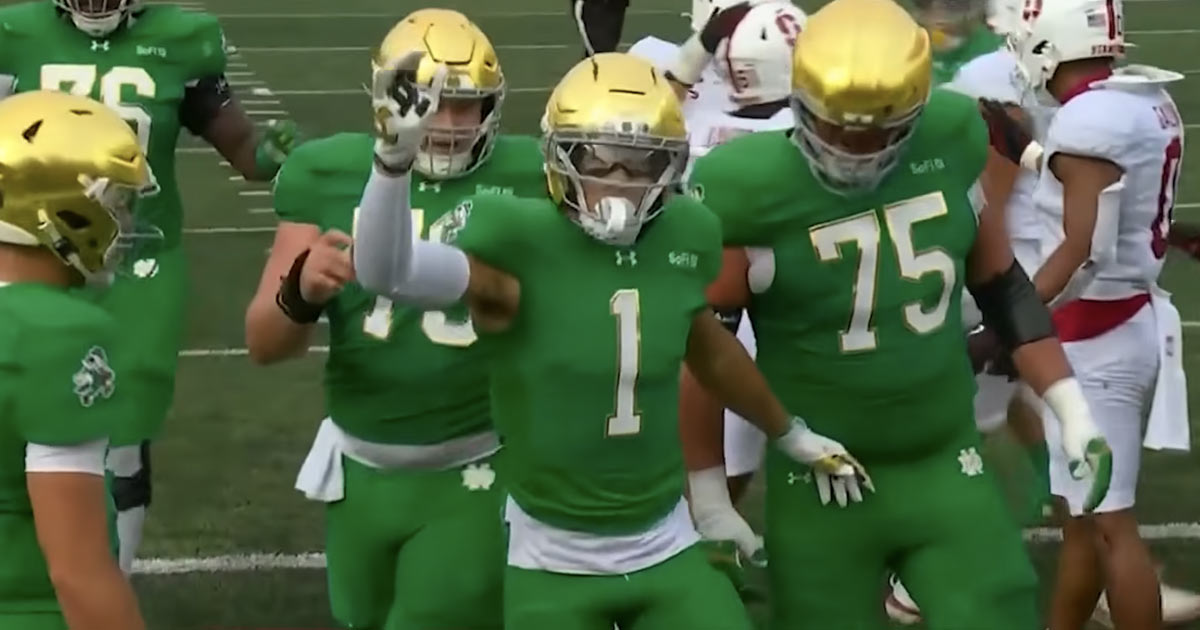
The Notre Dame Fighting Irish delivered one of their most impressive performances of the 2026 college football season on Saturday, October 10, rolling past the Stanford Cardinal 58-7 at Notre Dame Stadium in South Bend, Indiana. Notre Dame combined explosive offensive plays, a relentless rushing attack and a dominant defensive effort to improve to 6-0 and extend its winning streak to 16 games.
The No. 3-ranked Fighting Irish wasted little time establishing control of the game. Notre Dame forced an early turnover, built a commanding halftime lead and continued to find the end zone throughout the second half. Freshman running back Jonaz Walton stole the spotlight with a record-setting performance, while quarterback CJ Carr and several other Irish playmakers helped turn the matchup into a one-sided contest.
For Notre Dame fans, the victory was another encouraging sign that the Fighting Irish have the offensive firepower and defensive toughness needed to compete at the highest level.
Notre Dame Sets the Tone From the Opening Play
The game could hardly have started better for the Irish defense. On Stanford’s first offensive play, Notre Dame defensive lineman Boubacar Traore broke through the protection, sacked quarterback Davis Warren and forced a fumble. Linebacker Jaiden Ausberry recovered the loose ball at the Stanford 18-yard line, immediately putting the Irish offense in excellent scoring position.
Notre Dame took advantage of the opportunity, with Nolan James Jr. finishing the short drive with a touchdown run. The early score established the tone for an afternoon in which Stanford struggled to find offensive rhythm.
The Irish defense continued to pressure Warren, disrupt passing plays and force punts. Stanford managed only 202 total yards for the game, including just 58 rushing yards, while Notre Dame’s offense repeatedly turned favorable field position into points.
Jonaz Walton Makes Notre Dame History
The biggest individual story of the afternoon belonged to freshman running back Jonaz Walton. He rushed for a game-high 181 yards on just 13 carries, averaging an outstanding 13.9 yards per attempt while scoring twice.
Walton’s signature moment came early in the second quarter. With Notre Dame backed up near its own goal line, the freshman found a massive opening on the right side of the offensive line and sprinted 97 yards for a touchdown.
The spectacular run was the third-longest offensive play in Notre Dame Stadium history, falling just short of the 98-yard touchdown runs recorded by Josh Adams in 2015 and Jeremiyah Love in 2024.
Walton was not finished. He later broke free for a 40-yard touchdown run in the fourth quarter, demonstrating that Notre Dame’s rushing attack remained dangerous even after the starting offense began giving way to younger players.
His performance was a major highlight of the victory and provided Notre Dame with another promising young playmaker in the backfield.
CJ Carr Delivers Three Touchdown Passes
Quarterback CJ Carr had an efficient afternoon directing the Irish offense. Carr completed 14 of 20 passes for 181 yards and three touchdowns without throwing an interception. He also contributed 41 rushing yards on five carries.
Carr connected with Jaden Greathouse for a three-yard touchdown late in the first quarter, capping a sustained drive that helped Notre Dame extend its lead to 14-0.
In the second quarter, Carr delivered one of the game’s biggest passing plays. Aneyas Williams lined up as a receiver, got behind the Stanford defense and caught a deep pass before racing downfield for a 70-yard touchdown. The explosive play helped Notre Dame take a 37-0 lead into halftime.
Carr added his third touchdown pass in the third quarter, finding Elijah Burress for a 30-yard scoring strike. The reception was Burress’s first career touchdown catch, making it a memorable milestone in a game full of standout performances.
Carr’s combination of accuracy, decision-making and mobility allowed Notre Dame to attack Stanford in multiple ways.
Nolan James Jr. Provides a Powerful Ground Game
While Walton produced the most spectacular runs, Nolan James Jr. played an important role in establishing Notre Dame’s dominance.
James finished with 73 rushing yards on 10 carries and two touchdowns. His first score came on a short run following the opening defensive turnover, giving Notre Dame an early advantage.
His second touchdown was even more impressive. In the second quarter, James found room behind the Irish offensive line and broke away for a 31-yard scoring run. The play extended Notre Dame’s lead to 30-0 and reinforced the team’s control of the game.
James continued contributing after halftime, helping Notre Dame sustain drives and wear down the Stanford defense. His production gave the Irish another dependable rushing option alongside Walton.
Aneyas Williams and Elijah Burress Make Big Plays
Notre Dame’s passing game benefited from timely contributions by its receiving targets.
Williams was especially effective as a versatile offensive weapon. Although he recorded only 28 rushing yards on seven carries, his 70-yard touchdown reception demonstrated his ability to turn a single opportunity into a game-changing play.
Burress also made the most of his opportunity. His 30-yard touchdown catch from Carr in the third quarter pushed Notre Dame’s lead to 44-0 and marked an important career milestone for the young receiver.
Greathouse contributed three receptions for 30 yards, including his first-quarter touchdown. Together, these players helped ensure that Stanford could not focus exclusively on stopping Notre Dame’s powerful running game.
Notre Dame’s Offensive Line Opens the Door
The Irish offensive line deserves significant credit for the team’s success on the ground. Notre Dame finished with approximately 360 rushing yards and nearly 600 yards of total offense, consistently finding openings against Stanford’s front seven.
The blocking on Walton’s 97-yard touchdown was particularly impressive. Cooper Flanagan, Ashton Craig and Guerby Lambert helped clear the right side, allowing Walton to reach the open field and outrun the Cardinal defense.
The line also helped create opportunities for James, whose two touchdown runs showed that Notre Dame could generate explosive plays from multiple running backs.
Notre Dame’s ability to combine long scoring runs with sustained drives made the offense difficult to contain throughout the afternoon.
Boubacar Traore Leads a Dominant Defensive Effort
The Notre Dame defense was just as impressive as the offense. Traore’s opening-play strip-sack immediately changed the game’s momentum, and he later intercepted a Stanford pass to give the Irish another takeaway.
Senior captain Drayk Bowen led Notre Dame with six tackles, helping anchor a defense that limited Stanford to nine first downs and only 202 total yards.
Jayden Sanders also made important contributions in the secondary. Making his first start in an Irish uniform in place of the injured Leonard Moore, Sanders broke up two passes on third down during the early stages of the game, helping force Stanford punts.
Mark Zachary IV added an interception on Stanford’s final pass attempt, ensuring that the Cardinal would not produce another scoring opportunity late in the contest.
Notre Dame held Stanford scoreless through the first half and forced three turnovers without committing one of its own. That combination of pressure, coverage and ball security played a major role in the lopsided result.
Javian Osborne Helps Finish the Job
Notre Dame continued scoring after the game was well in hand. Stanford finally got on the scoreboard late in the third quarter when Warren connected with Benji Blackburn for a three-yard touchdown, following a 52-yard completion to Caden High.
The Irish responded with another explosive run from Walton, who scored from 40 yards out to make it 51-7.
Freshman running back Javian Osborne then supplied the game’s final touchdown with a three-yard run in the fourth quarter. Osborne’s score capped a long, methodical drive and highlighted Notre Dame’s depth at running back.
Noah Grubbs also saw action at quarterback during the second half, completing five of seven passes for 56 yards while helping the Irish maintain their offensive rhythm.
Notre Dame ultimately finished with 58 points, 597 total yards, 26 first downs and eight touchdowns. The offense produced five touchdowns on plays of at least 30 yards, illustrating just how explosive the Irish were against Stanford.
What Notre Dame’s Win Means Moving Forward
The 58-7 victory was about more than improving the team’s record. It demonstrated that Notre Dame could generate offense through the air and on the ground while maintaining pressure on opposing quarterbacks and creating turnovers.
Walton’s historic freshman performance was an obvious highlight, but the Irish also received productive outings from Carr, James, Williams, Burress and the offensive line. On defense, Traore, Bowen, Sanders, Ausberry and Zachary helped deliver a complete team performance.
Notre Dame’s 6-0 start and 16-game winning streak provide plenty of reasons for optimism. The challenge now is to maintain that level of execution as the schedule continues and the competition gets tougher.
If the Fighting Irish can continue protecting the football, creating explosive plays and defending with the intensity displayed against Stanford, they will remain a formidable opponent for the rest of the 2026 season.
For now, Notre Dame fans can celebrate a convincing victory that featured a record-setting run, three touchdown passes from Carr and a defense that controlled the game from the opening snap.
Check out the game highlights:
Notre Dame vs. Stanford Game FAQ
What was the final score of the Notre Dame vs. Stanford football game?
Notre Dame defeated Stanford 58-7 on Saturday, October 10, 2026, at Notre Dame Stadium in South Bend, Indiana.
Who was Notre Dame’s leading rusher against Stanford?
Freshman Jonaz Walton led the Irish with 181 rushing yards on 13 carries. He averaged 13.9 yards per carry and scored two rushing touchdowns.
How long was Jonaz Walton’s longest touchdown run?
Walton’s longest touchdown was a 97-yard run early in the second quarter. It was the third-longest offensive play in Notre Dame Stadium history.
How did CJ Carr perform against Stanford?
Carr completed 14 of 20 passes for 181 yards and three touchdowns without an interception. He also rushed for 41 yards.
Which Notre Dame players scored touchdowns?
Nolan James Jr. scored two rushing touchdowns, Jonaz Walton scored twice on the ground, and Javian Osborne added a rushing touchdown. Jaden Greathouse caught a touchdown pass from Carr, as did Aneyas Williams and Elijah Burress.
Who scored Notre Dame’s first touchdown?
Nolan James Jr. scored the opening touchdown on a short rushing play after Boubacar Traore forced a fumble that Jaiden Ausberry recovered on Stanford’s first offensive possession.
How did Notre Dame’s defense perform?
The Irish limited Stanford to 202 total yards, including 58 rushing yards, and forced three turnovers. Traore recorded a strip-sack and an interception, while Mark Zachary IV intercepted a pass late in the game.
What was Notre Dame’s record after beating Stanford?
Notre Dame improved to 6-0 following the victory and extended its winning streak to 16 games.
Who scored Notre Dame’s final touchdown?
Freshman running back Javian Osborne scored on a three-yard run in the fourth quarter, completing the scoring in Notre Dame’s 58-7 victory.
What was the biggest takeaway from Notre Dame’s win?
The biggest takeaway was Notre Dame’s balance and explosiveness. The Irish combined a dominant rushing attack, efficient quarterback play and a defense that forced turnovers to produce one of their most convincing victories of the season.
The win also showcased the potential of freshman Jonaz Walton, whose record-setting performance added another exciting dimension to Notre Dame’s offense.